
Dune: Awakening's Alternate Timeline Still Feels Like a Survival Dream in 2026
Dune: Awakening's alternate timeline turns the survival MMO into a living Atreides-Harkonnen war where Duke Leto lives and player choices matter.
I still remember how mysterious Dune: Awakening felt when Funcom first began talking about it, and in 2026 I find the game's central storytelling choice even more interesting than its sandworms. The survival MMO does not simply adapt Frank Herbert's Dune; it lives in an alternate timeline, a 'what-if' branch that begins several years after the original novel's events but unfolds differently. According to creative director Joel Bylos, Funcom worked closely with the Herbert family and Legendary Pictures to find 'a single pebble that starts a landslide.' That image stuck with me because it captures exactly what the game feels like: familiar enough to recognize, different enough to make every faction, character, and desert route feel newly dangerous.
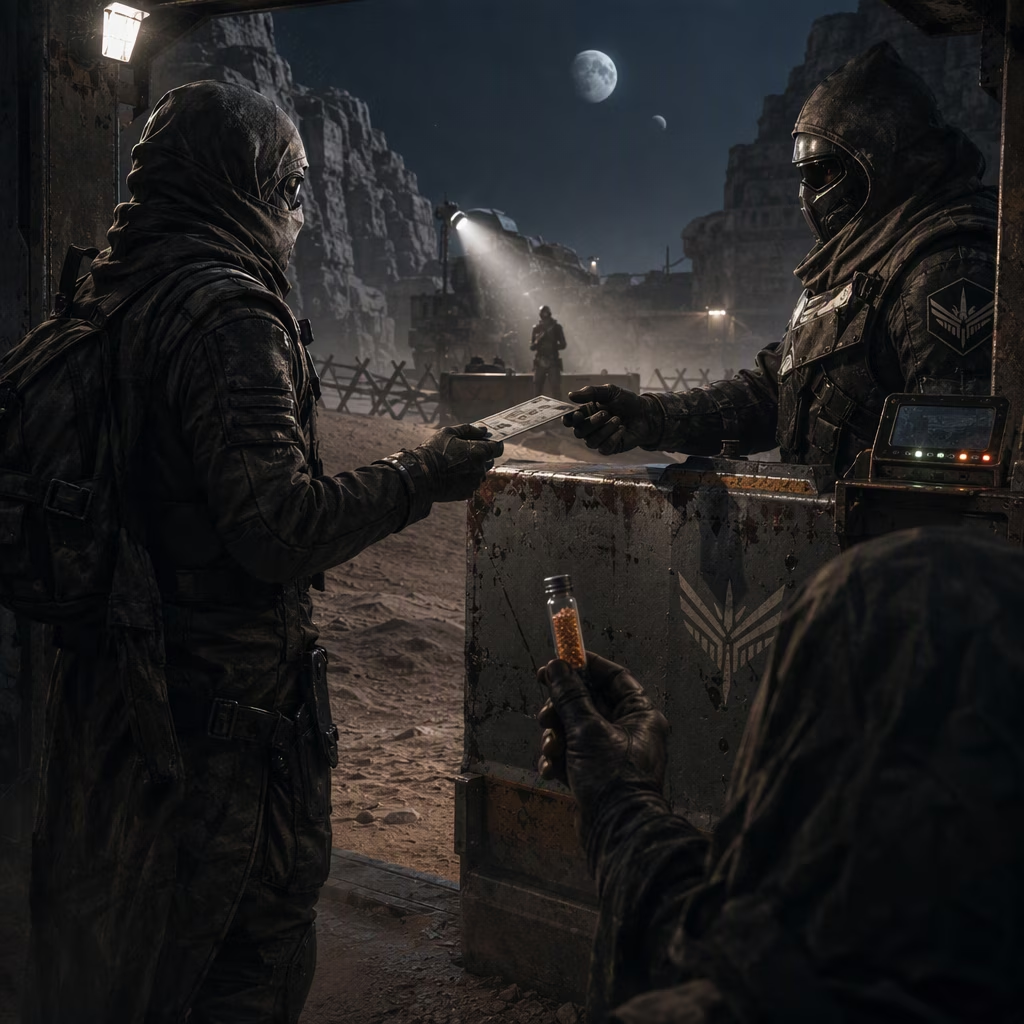
The most immediate consequence is Duke Leto Atreides. In Herbert's 1965 novel, Duke Leto is assassinated about a third of the way through the story, and his death sets Paul's path in motion. In Dune: Awakening, he is alive. That changes the war between House Atreides and House Harkonnen for control of Arrakis, the universe's most resource-rich planet. I like this not because I want a power fantasy where nothing bad happens, but because the survival sandbox gains political weight. When I help 'a certain group of people' and jump through 'a lot of hoops,' as Bylos put it, I can align myself with the Duke and House Atreides. The game does not hand me that alliance; I have to earn it, and that makes the faction feel like a real commitment rather than a menu choice.
Why the Alternate Timeline Works for Me
I have played enough survival games to know that lore can become wallpaper. Dune: Awakening avoids that trap by making the timeline itself a gameplay hook. If Duke Leto lives, then the Atreides-Harkonnen conflict is not a fixed historical event I am merely touring. It is a living war with room for player intervention. I can imagine my character as a small but meaningful variable in a much larger equation, which is exactly what an MMO should offer.
Funcom has also said it plans to support the game after launch with more characters, and in 2026 that forward-looking approach feels essential. An alternate timeline is only as strong as the characters who inhabit it. New faces, new faction angles, and new political complications can keep Arrakis from becoming a static museum of Herbert's ideas. I want the game to surprise me with people I thought I knew, not just with another tier of crafting materials.
Survival on Arrakis in 2026
The survival loop is where the alternate timeline becomes physical. Bylos has said the game takes inspiration from Valheim for some of its survival systems, and I can feel that DNA in the way preparation matters. I do not simply run across the dunes; I read the environment, manage risk, and decide when to retreat.
| System | What I do | Why it matters |
|---|---|---|
| 🪱 Sandworms | Avoid attracting them | One wrong vibration can turn a routine trip into a disaster |
| 🌪️ Sandstorms | Seek shelter | The storm is both a threat and a map-changing event |
| 💧 Water and spice | Maintain levels | Survival depends on resource discipline, not just combat skill |
| 🗺️ Shifting locations | Race to newly revealed places | Rare crafting schematics reward speed and preparation |
The sandstorms are my favorite idea. They periodically reveal or cover locations on the map, which means the terrain is never just scenery. When a storm uncovers a new site, I feel a rush of opportunity and anxiety at the same time. Someone else might get there first. Someone else might claim the rare crafting schematics. That competitive edge gives Dune: Awakening a pulse that a static open world often lacks.
The Desert Still Feels Dangerous
What I appreciate most in 2026 is that Dune: Awakening does not treat Arrakis as a backdrop for power fantasy. The sandworms, the storms, the water discipline, and the spice economy all push me to respect the planet. The alternate timeline gives me political hope, but the desert keeps me humble. I can ally with House Atreides, chase rare schematics, and build a future in a branching history, but I still have to survive the next storm. That combination of grand narrative and gritty survival is why the game's 'what-if' premise still works for me. It is not a rejection of Dune; it is a way to explore Dune from a new angle, one where the landslide has already started and I am standing somewhere inside it.
Leave a Comment
0 Comments