
Dune: Awakening Endgame Unveiled: Landsraad Politics and Customizable Combat Systems
Dune Awakening endgame revolves around the Landsraad council, where player-driven politics shape server-wide policies and combat.
The desert winds of Arrakis carry whispers of power, intrigue, and a future shaped not by a prophesied messiah but by the actions of thousands of players. In a recent developer livestream, Funcom unveiled a comprehensive look at the endgame systems awaiting those who survive the harsh sands of Dune: Awakening. This open-world survival MMO, set in an alternate timeline where Paul Atreides was never born, has been steadily building anticipation, and now the studio has pulled back the curtain on the political machinations of the Landsraad and the deeply modular combat framework that defines high-level play. The showcase, delivered in early 2026, provided the first real glimpse into the content that lies beyond the early survival grind, leaving the community abuzz with strategic possibilities.
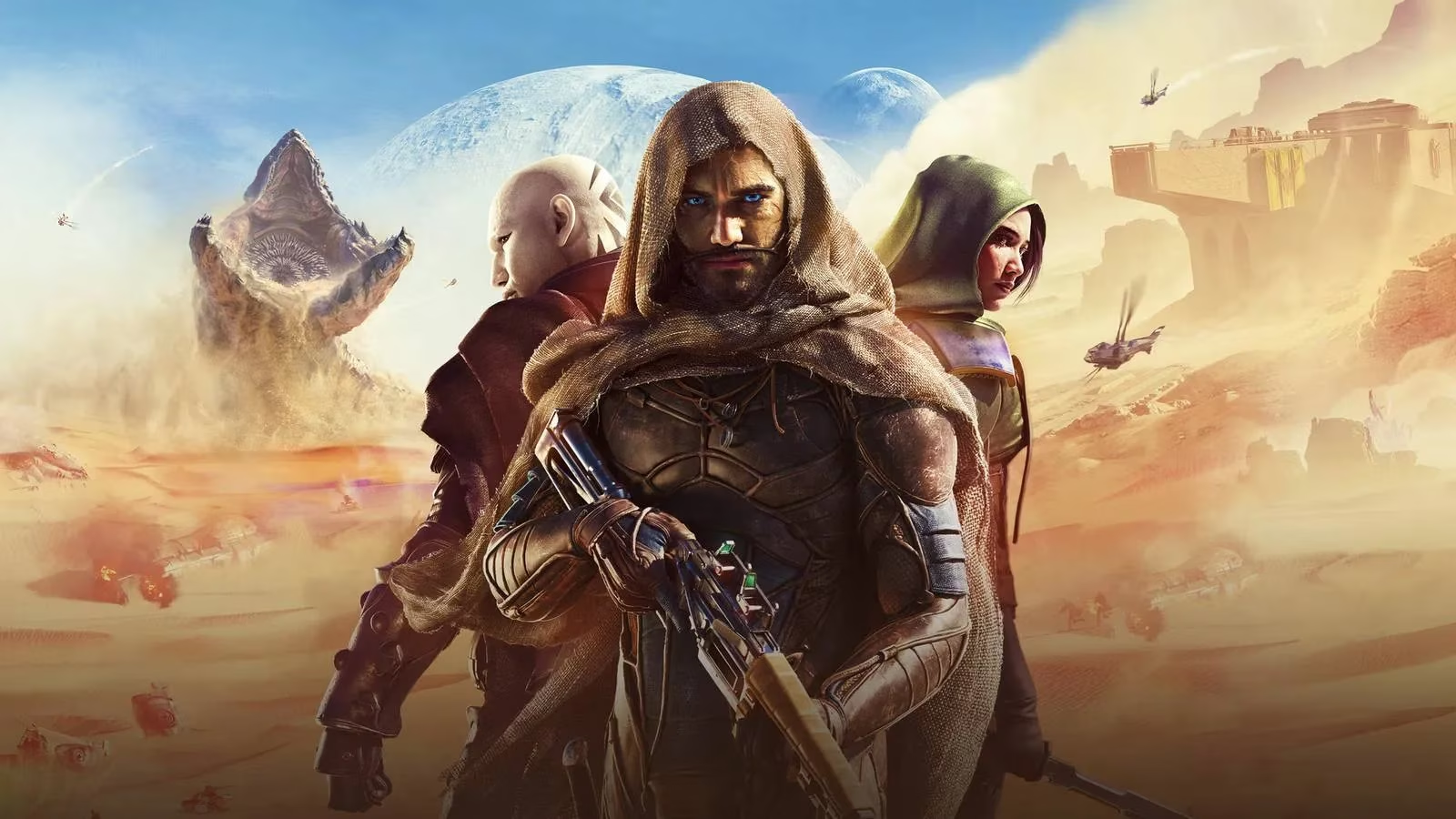
The heart of Dune: Awakening’s endgame is the Landsraad, a political council that elevates faction warfare from simple territory control to a grand stage of diplomacy and deception. Unlike traditional MMO endgames that revolve solely around raid bosses or PvP arenas, the Landsraad introduces a dynamic governance layer that spans entire server clusters, known as Worlds. Representatives from the Great Houses—initially House Atreides and House Harkonnen, with the potential for others to emerge—convene regularly to debate, negotiate, and vote on policies that reshape the player experience. These policies can range from economic tariffs on spice trading and resource distribution rates to large-scale military doctrines that influence how PvP engagements unfold across the map. A single vote might lower the cost of deploying ornithopters for a week, or it could trigger a server-wide event that requires all factions to collaborate against a common Sandworm threat. The developers emphasized that every decision made within the council chambers has tangible, lasting consequences, making political maneuvering as vital as combat skill.
The Landsraad is not a static, scripted system; it is fueled entirely by player agency. Houses send their chosen diplomats—players who have earned influence through quests, spice contributions, or battlefield victories—to argue their case before the council. Backroom deals, alliances of convenience, and public betrayals are expected to become the norm. Funcom’s design encourages emergent storytelling, where a minor House can rise to prominence by swaying a crucial vote or exposing a rival’s scheme. This political sandbox, combined with the ever-shifting alliances of a player-driven narrative, ensures that no two server cycles unfold in precisely the same way. In the spring of 2026, testers who gained early access to this system reported that council sessions often turned into tense, multi-hour debates that felt ripped straight from the pages of Frank Herbert’s novels.
A broader look at the combat system reveals how the Schools of the Imperium tie directly into this endgame landscape. At character creation, players align with one of four distinct Schools, each offering a unique starting ability and a specialized skill tree that shapes a character’s entire combat philosophy. While Funcom has not divulged all four names, community speculation based on in-game lore hints at traditions akin to the Mentats, Swordmasters, and Spice Navigators. One confirmed School focuses on melee precision and dueling, rewarding timing and parries, while another emphasizes ranged attacks and environmental manipulation—perhaps using sonic weapons or lasgun arrays. A third School might delve into the forbidden arts of Bene Gesserit-inspired Voice commands and body control, offering crowd-control and support roles. The fourth could channel the prescient calculation abilities to predict enemy movements or enhance vehicle operations.
What makes the progression system truly special is the cross-School learning mechanic. As players explore Arrakis, complete faction missions, and master the deadly rhythms of desert life, they can unlock abilities from Schools other than the one they initially chose. This means a Swordmaster can eventually learn a dose of Mentat-like tactical analysis, or a ranged specialist can incorporate close-quarters knockdown powers. By the time players reach the endgame and step onto the Landsraad floor, their combat builds are deeply personalized hybrids. This flexibility encourages experimentation and ensures that veteran characters feel unique rather than carbon copies of a meta template.
Combat itself is a seamless blend of melee strikes, ranged weaponry, vehicle-mounted ordnance, and supernatural abilities. Skirmishes often begin at a distance with sniper fire from rocky outcrops or cannons mounted on ornithopters, then collapse into brutal knife fights as soldiers close the gap. The iconic personal shields from the Dune universe force players to choose their tools carefully—lasgun-shield interactions remain as deadly and unpredictable as they are in the lore. Vehicle combat adds another visceral layer; sand-bikes race through dust storms while harvesters desperately guard their spice loads from raiders. The entire system feels frantic, tactical, and deeply grounded in the Dune aesthetic.
Funcom’s deliberate pacing in revealing this content speaks to the complexity of what they’ve built. The earlier public beta, which ran in May 2025, gave players a taste of crafting, base building, and the early-game struggle for water and shelter. At that time, the late-game layers remained locked behind data walls, yet the beta still drew nearly 40,000 concurrent players eager to test their mettle on Arrakis. Now, with the full reveal, those survivors finally understand what awaits them once they’ve learned to walk without rhythm. The Landsraad and the advanced combat systems are not mere additions; they represent the core pillars of Dune: Awakening’s long-term appeal. In a genre often criticized for repetitive treadmill-based endgames, Funcom seems poised to deliver something genuinely unpredictable and socially driven.
As 2026 marches on, the game’s launch window approaches amid heightened expectations. Community feedback from the recent preview has been overwhelmingly positive, with veterans of survival MMOs praising the political depth and the combat’s modular design. The promise of a living, breathing Arrakis where player ambition can alter the course of a World is no longer a distant mirage. It is a tangible reality, shimmering on the horizon like a spice blow—ready to be seized by those bold enough to claim it.
Leave a Comment
0 Comments