
Dune: Awakening Drives Another Nail Into the Xbox Series S Optimization Coffin
Xbox Series S optimization challenges frustrate developers like Funcom, impacting Dune: Awakening's console release timeline.
I\u2019ve lost count of how many times I\u2019ve heard a developer sigh when the Xbox Series S comes up in conversation. If I had a stack of arcade tokens for every studio that called it a \u201cchallenge,\u201d I\u2019d be swimming in them like Scrooge McDuck. The latest piece of deja vu comes from Funcom, the team deep in the sands of Arrakis with the ambitious survival MMO Dune: Awakening. Their frustration is just another grain of sand in a growing storm\u2014one that probably won\u2019t settle in 2026.
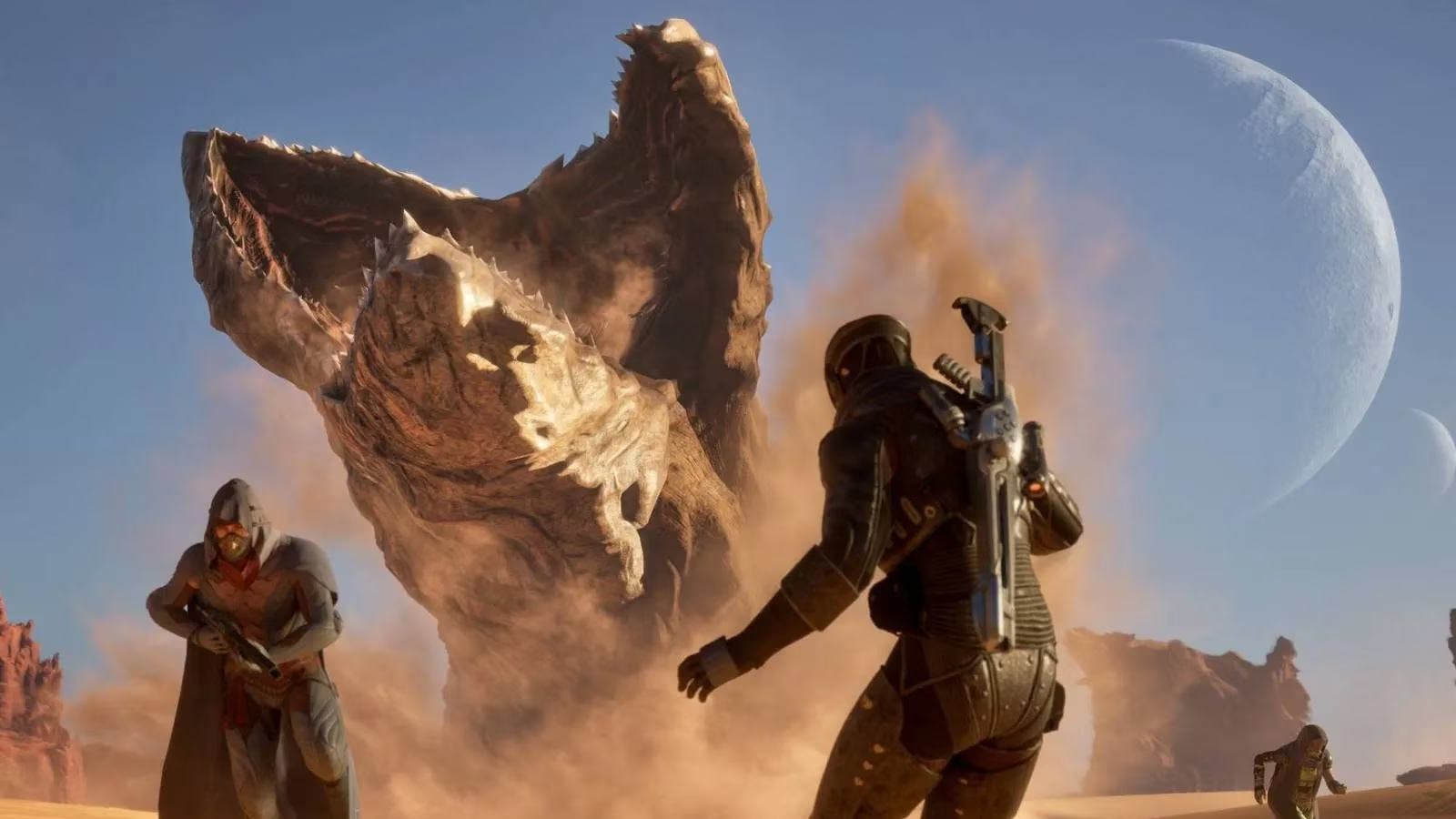
Scott Junior, Funcom\u2019s chief product officer, recently told VG247 that bringing their vision to Microsoft\u2019s budget console is \u201ca challenge.\u201d That\u2019s the diplomatic way of saying you\u2019re trying to squeeze a sandworm through a stillsuited straw. The game\u2019s massive environments, large-scale battles, and jaw-dropping visuals already push high-end PCs to their limits. Asking a Series S to run the same simulation is like demanding a three-legged moose compete in a synchronized swimming routine\u2014technically possible with enough creative engineering, but nobody\u2019s watching for grace.
Junior didn\u2019t mince words about the timeline, either: \u201cIt\u2019s one of the reasons we\u2019re coming out on PC first. There\u2019s a lot of optimizations we need to do before we release on the Xbox.\u201d Those of us who\u2019ve followed the console\u2019s history nodded in grim recognition. The Series S has become the uninvited guest at every developer party\u2014the one you can\u2019t kick out because Microsoft promised it a forever seat at the table.
If Junior\u2019s comments sound familiar, it\u2019s because we\u2019ve been listening to this same howl since 2020. Just the other week, I was remembering how ex-Naughty Dog and Rocksteady developer Del Walker caused a minor internet earthquake by saying he wished the Series S \u201cnever existed.\u201d He later elaborated that building a high-end game with complex AI, advanced physics, multi-threading optimization, and dynamic memory systems only to then hack away at it until it limps onto a weaker console feels like composing a symphony and then being told the orchestra can only use kazoos.
Remedy\u2019s Thomas Puha echoed that sentiment ages ago, noting that the optimization process isn\u2019t the flip-of-a-switch some players imagine. And then there\u2019s the grand epic of Larian\u2019s Baldur\u2019s Gate 3. That game\u2019s journey to the Series S became a full-blown saga\u2014one so tangled that Microsoft sent its own engineers to Switzerland to help sort out the technical knot. The fact that such a gesture was necessary from the platform holder should tell you everything: optimizing for the Series S isn\u2019t just a hurdle; it\u2019s an obstacle course designed by a sadist with a clipboard.
What makes the Series S so persistently thorny in 2026 isn\u2019t that it\u2019s weak\u2014it\u2019s that it was born from a beautiful but brutal dream. The console promised next-gen experiences at a lower resolution, but the catch was always the memory bandwidth and GPU grunt. Games that stream vast worlds, juggle thousands of network-synced entities, and calculate believable physics on the fly run headfirst into that memory ceiling like a moth against a window. Telling a studio to simply \u201cturn down the graphics\u201d misses the point by a light-year. You can\u2019t ask a surgeon to work with plastic cutlery just because the operation room is smaller.
As we drift further into 2026, the problem isn\u2019t going anywhere. Games are getting more complex, not less. AI systems are more demanding, particle effects are more lavish, and MMOs like Dune: Awakening proudly wear their ambition like a crysknife on a belt loop. The Series S remains a mandatory target for any game launching on Xbox, and that means developers will keep bending over backwards until their spines resemble a pretzel.
The silver lining\u2014if you can call it that\u2014is that these constraints sometimes force surprising innovation. Some studios discover clever rendering tricks that benefit all platforms. But the cost in frustration and delayed releases is real, and we as players pay it in patience. When I eventually step onto the sands of Arrakis on my PC in Dune: Awakening, I\u2019ll know a part of its codebase is still wrestling with a tiny console that refuses to be ignored. Until Microsoft decides that no game is worth tying to that anchor anymore, we\u2019ll just keep adding quarters to the jar\u2014and my pockets are getting heavy.
Leave a Comment
0 Comments