
Dune: Awakening - A Faithful Yet Monotonous Trek Across the Sands of Arrakis
Dune: Awakening masterfully recreates the harsh, spice-saturated world of Arrakis with stunning visual fidelity and immersive survival mechanics. However, the game's slavish devotion to the desert aesthetic reveals a core weakness, as the survival genre's reliance on diverse biomes clashes with the planet's monotonous, sprawling sands.
Let me tell you, stepping into Dune: Awakening feels less like booting up a new game and more like finally arriving on that dusty, spice-saturated hellscape I've read about and seen in the movies. As a professional gamer who's seen countless IP adaptations stumble, I went in with my shields up, ready to critique any deviation. But Funcom? They've done something impressive and, honestly, a bit baffling. They've recreated Arrakis with such slavish devotion that I can almost taste the sand in my mouth and feel the sun trying to vaporize me. The aesthetic is a home run for any fan. The problem is, after the initial awe wears off, you realize you've just signed up for a very, very long walk in a very, very big desert.
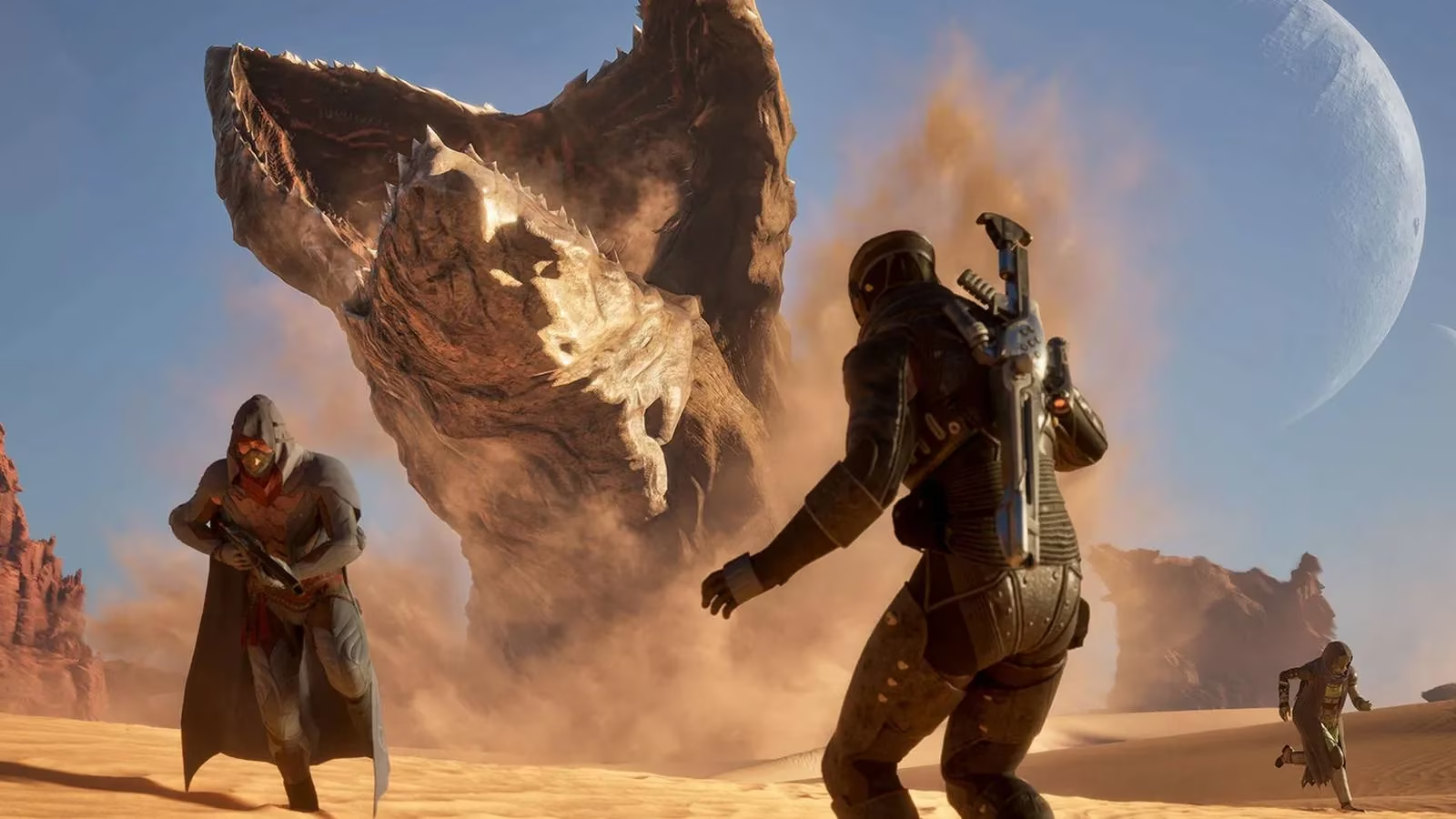
Arrakis: A Planet of Sand, Spice, and... More Sand
Frank Herbert and Denis Villeneuve painted a picture of a planet so harsh it forges the toughest people in the universe. Funcom has taken that canvas and rendered it in stunning, unforgiving detail. From the second you crawl out of your initial shelter (probably a hole in the ground), the game's environment hits you with a one-two punch:
-
Visual Fidelity: The dunes stretch to a shimmering horizon, rock formations cast long, sharp shadows, and the light has that specific, oppressive quality that makes you squint at your screen.
-
Mechanical Harshness: This isn't just for show. You must manage your exposure to the sun, listen for the subterranean rumble of a sandworm, and pray you find shade before a storm scours your flesh from your bones.
It's a masterclass in atmospheric world-building. The settlements feel like desperate outposts clinging to life, and building your own base feels like a genuine act of defiance against the planet itself. The sound design, from the howling winds to the silence of the deep desert, is impeccable. For the first few hours, I was utterly absorbed. This was Dune. I was on Arrakis. I was... starting to get really bored of looking at sand.
The Survival Genre's Greatest Strength vs. Dune's Greatest Weakness
Here's the rub, the core conflict at the heart of Dune: Awakening. The survival game genre thrives on diversity and discovery. Think about the titans:
| Game | Key Biomes/Areas | Core Loop Driver |
|---|---|---|
| Minecraft | Forests, Oceans, Mountains, Deserts, Tundras, Jungles, Nether, End | Exploration & Resource Variety |
| Valheim | Meadows, Black Forest, Swamp, Mountains, Plains, Ocean, Mistlands | Progressive Biome Challenges |
| Ark: Survival Evolved | Tropical, Arctic, Desert, Redwood, Ocean, Volcanic, Aberration | Taming & Exploring Diverse Ecosystems |
These games use environmental variety to gate progression, introduce new resources, and present fresh visual and gameplay challenges. Your journey is marked by leaving one distinct area and struggling to adapt to the next.
Dune: Awakening's Arrakis, by its very canonical nature, offers none of that. The planet is, famously, a "desert planet." Funcom's commitment to authenticity means:
-
❌ No hidden forests.
-
❌ No snowy mountain peaks.
-
❌ No sprawling lakes or rivers (outside of maybe a precious sietch reservoir).
-
✅ Sand.
-
✅ Different-colored sand.
-
✅ Rocks.
-
✅ Bigger rocks.
My gameplay loop quickly distilled into: Leave base → traverse kilometers of identical-looking dunes → find a rock outcropping with a resource node → avoid worm → traverse identical dunes back home. Rinse and repeat. The thrill of discovering a new "biome" is replaced by the relief of finding a cave to escape the sun. It's thematically perfect and, from a long-term engagement perspective, a potential recipe for player attrition.
The Spice Must Flow... But So Should the Gameplay
So, is the game doomed to monotony? Not necessarily. Funcom seems acutely aware of the challenge they've built for themselves. They can't add pine trees to Arrakis any more than they could add a Shai-Hulud to a swimming pool—it would break the fiction. Therefore, the engagement has to come from elsewhere, and I see them laying the groundwork in a few key areas:
-
Verticality & Subterranean Exploration: While the surface is uniform, the real variety might be found above and below. Imagine soaring with an ornithopter to navigate canyon networks or delving deep into vast, ancient underground Fremen sietches that are more complex than simple caves. This creates "biomes" of a different kind.
-
Human Conflict as the "Ecosystem": On a planet with little ecological variety, the diversity comes from its inhabitants. The conflict between the Great Houses, the smuggler factions, and the Fremen could create dynamic, shifting territories on the map that feel vastly different to navigate. A zone controlled by a hostile House might be a maze of patrols and defenses, while a Fremen zone might be about navigating hidden paths and earning trust.
-
Spice-Driven Metamorphosis: The spice melange is the heart of Dune. What if prolonged exposure or harvesting in certain rich fields temporarily altered the local environment or the player's perception, creating surreal, dream-like sequences or hazards? This would introduce variety that is 100% lore-friendly.
-
Base Building & Politics: If the world itself is static, then the player's impact on it needs to be profound. Deep, customizable base building that affects local politics, economy, and even the landscape (moisture farming on a large scale?) could become the primary end-game driver, rather than exploration for its own sake.
A Gamble on Authenticity
Playing Dune: Awakening in 2026 feels like witnessing a bold experiment. In an era where open-world games compete to have the most checklists and the most visually diverse maps, Funcom has deliberately made a game about one thing: surviving on Arrakis. They've traded the genre's typical breadth for an unprecedented depth of atmosphere.
Will it work? 🤔
For the hardcore Dune enthusiast who wants to live the fantasy, it's a dream come true. The authenticity is a feature, not a bug. For the survival game veteran looking for the next Valheim-like journey of discovery across varied lands, they might find Arrakis to be a beautiful, but ultimately repetitive, slog.
My professional take? Funcom is walking a knife's edge. They've built a stunning, faithful world that perfectly captures the soul of Dune. Their success now hinges entirely on their ability to layer incredibly compelling human-driven systems—complex faction warfare, deep economic play, and meaningful base-building—on top of that monolithic environment. If they can make the conflict for control of the spice as engaging as the fight against the environment, they'll have created something truly unique. If not, even the most devoted fans might eventually find that, in the wise words of the Fremen, "the desert takes the weak." And in this case, the weak might be our attention spans.
Leave a Comment
0 Comments